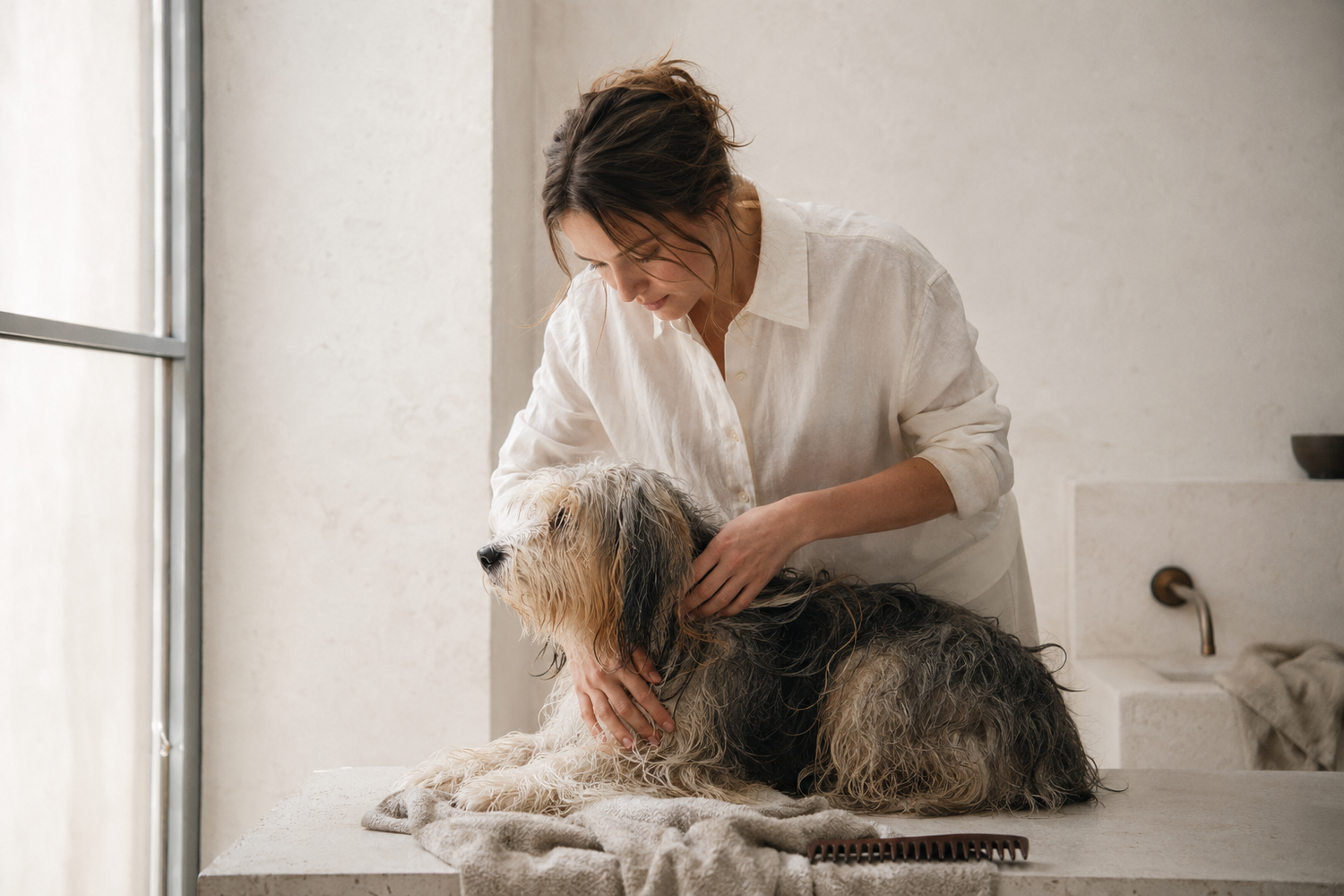
Dog conditioner is not a mandatory addition after every bath. However, it becomes very practical when the coat is rough, static, easily tangled, or requires long and unpleasant detangling after washing. It is most often used by dogs with long, wavy, curly, or dense coats.
A well-chosen conditioner helps reduce friction between hairs, facilitates brush handling, and leaves the coat softer to the touch. However, it does not replace regular brushing, does not treat skin diseases, and does not automatically remove severe mats. Three things are key: a product designed for dogs, the right type of formula, and precise application according to the label.
In short: does your dog need conditioner?
- Yes, probably: if the coat is long, wavy, curly, dense, dry, or prone to tangling.
- May be helpful: after the sea, frequent baths, or during intensive grooming when the hair has become more difficult to detangle.
- Not necessarily: if the dog has a short, healthy coat, and the brush goes through it easily after washing alone.
- Vet first: if you see itching, redness, dandruff, sores, hair loss, unpleasant skin odor, or recurring irritations.
What exactly does dog conditioner do?
Shampoo primarily cleanses the skin and coat. After rinsing, the hair may need additional smoothing – especially when it is long, porous, dry, or frequently bathed and dried. VCA Animal Hospitals states that conditioners designed for animals help smooth the hair surface, limit moisture loss, and facilitate subsequent detangling, particularly in long-haired dogs.
In everyday language, this means less tugging with the brush and a calmer ritual for the dog. However, conditioner does not change the natural coat type. It should not weigh down the hair with excess product or mask dermatological symptoms with scent. The effect should be functional: easier brushing, greater softness, and a well-groomed appearance.
When is conditioner particularly useful?
1. Long, silky, or wavy coat
The longer the hair, the greater the contact surface and the risk of tangles. Conditioner can facilitate detangling areas behind the ears, under the armpits, on the paws, belly, and tail – i.e., places where mats most often form. It does not replace brushing, but it can make it gentler.
2. Curly or dense coat
A curly coat easily traps loose hairs and small debris. A dense undercoat, on the other hand, requires very thorough distribution, rinsing, and drying. In both cases, a small amount of the right product can improve glide during brushing, but an excess left near the skin will have the opposite effect: it will weigh down the coat and can cause discomfort.
3. Dry or dull coat after bathing
If the hair regularly becomes rough after shampooing, check the entire ritual: water temperature, bathing frequency, amount of cosmetic, and thoroughness of rinsing. Conditioner can be the next step, but it should not be used to fix mistakes such as overly frequent washing or using a human product.
4. After the sea, travel, or an intense summer
Salt, sand, more frequent rinsing, and drying can make the hair more difficult to detangle. First, remove impurities and rinse the coat thoroughly, then apply conditioner when its condition requires it. A full ritual after swimming can be found in the guide Dog at the sea and lake - how to care for the coat after bathing?.
When is conditioner not necessary?
A short, smooth, and healthy coat often remains easy to care for after a gentle shampoo and thorough rinsing. If there are no tangles, dryness, or difficulty brushing, adding another cosmetic is not an end in itself. Instead of multiplying products, choose the smallest routine that provides comfort to your dog.
Do not use conditioner on irritated or damaged skin unless the label and veterinarian indicate otherwise. If the problem is itching, dandruff, redness, hair loss, or an unusual skin odor, a diagnosis is needed. A grooming cosmetic does not replace a medicinal preparation.
Rinse-off or leave-in conditioner?
| Type | When to use? | How to apply? |
|---|---|---|
| Rinse-off conditioner | After shampooing, during a full bath; especially for long, dense, wavy, or difficult-to-detangle coats. | On damp coat, for the time specified on the label, then rinse very thoroughly. |
| Leave-in spray conditioner | After bathing or between baths, when it is necessary to facilitate detangling of a clean coat. | A small amount on dry or slightly damp coat, if the manufacturer allows such use; do not rinse. |
| Detangling spray | For light tangles after a walk, trip, or before regular brushing. | Apply locally and gently detangle according to product instructions. |
Formulas are not interchangeable just because they have a similar name. A product labeled as rinse-off must be rinsed, and leave-in remains on the coat. Never guess the method of use based on consistency or packaging – always check the label.
How to use dog conditioner step by step?
- Brush your dog before bathing. Remove loose debris and minor tangles. Water can tighten existing mats.
- Wash your dog with dog shampoo. Choose it according to the skin, age, and coat type. If you don't know how often to give a full bath, check the guide How often to bathe your dog in summer?.
- Rinse the shampoo thoroughly. No residue should remain under the next layer of cosmetic.
- Squeeze out excess water. The coat should be damp, but not heavily dripping, unless the product instructions state otherwise.
- Apply a small amount of conditioner. Distribute it evenly along the length of the hair, especially on areas requiring easier detangling. Avoid eyes, nose, mouth, and inside the ears.
- Wait according to the label. Do not extend the contact time on your own, believing that the effect will be stronger.
- Rinse very thoroughly. This applies to any formula labeled as a rinse-off conditioner. The water should be lukewarm.
- Dry without vigorous rubbing. Gently blot water with a towel. With long hair, energetic rubbing can create new tangles.
- Brush calmly, in sections. Start from the ends, hold the hair closer to the skin, and move upwards. Do not pull if the dog reacts with pain.
How to use leave-in spray?
First, make sure the product is indeed labeled as leave-in. Apply a small amount to clean, dry, or slightly damp coat as instructed by the manufacturer. For a sensitive dog, it is better to spread the product on your hands or a brush than to spray it close to the head. Avoid eyes, nose, mouth, ears, and irritated skin. Then gently brush the hair and leave to dry.
PetsChoice.Club Conditioners
Two rituals, one need: easier brushing
Lemongrass scented rinse-off conditioner is a step after shampooing: it is applied to damp coat, left for 2-3 minutes, and rinsed thoroughly. Leave-in spray conditioner works well after bathing or between baths – on clean, dry, or slightly damp coat.
Choose a conditioner for your dog →Common mistakes when using conditioner
- Using human product. Human conditioner may have an inappropriate pH for dogs and ingredients irritating to the skin.
- Too much quantity. More product does not necessarily mean a better effect; it can weigh down the coat and make thorough rinsing difficult.
- Incomplete rinsing. If the formula requires rinsing, its residue should not remain on the skin.
- Applying to dirty coat. Conditioner does not replace cleansing and should not mask dirt or odor.
- Spraying near the muzzle. Apply the product away from the eyes, nose, mouth, and inside the ears.
- Brushing forcefully. Cosmetic is meant to facilitate work, but it does not remove pain caused by a tight mat.
- Ignoring skin reactions. Itching or redness after a new product is a sign to discontinue use.
FAQ — frequently asked questions
Is dog conditioner necessary after every wash?
No. It is especially useful for long, wavy, curly, dense, dry, or tangle-prone coats. A short, healthy, and easy-to-care-for coat may not need it. Observe the effect after bathing and use the product according to the label.
What is the difference between rinse-off conditioner and leave-in spray?
Rinse-off conditioner is typically used after shampoo on wet coat, left for the indicated time, and rinsed thoroughly. Leave-in spray can be used on clean dry or slightly damp coat before brushing or between baths. The instructions for the specific product are always most important.
Can I use human hair conditioner on a dog?
It should not be used for routine grooming. Human products may have an inappropriate pH and ingredients that cause irritation or itching. Choose a conditioner specifically formulated for dogs.
Will conditioner remove mats?
It can facilitate the detangling of minor snags, but it will not safely remove a tight mat close to the skin. Do not pull the coat and do not use scissors close to the body. A severely matted coat should be assessed by an experienced groomer or veterinarian.
Can spray conditioner be used on dry coat?
Yes, if the manufacturer allows it. Apply a small amount to clean, dry, or slightly damp coat, avoiding the head and irritated skin, then gently brush the hair.
What if the dog scratches after conditioner?
Discontinue use. If the product requires rinsing, rinse the coat thoroughly with clean lukewarm water. For redness, swelling, pain, severe itching, or persistent symptoms, contact your veterinarian.

Leave a comment
This site is protected by hCaptcha and the hCaptcha Privacy Policy and Terms of Service apply.