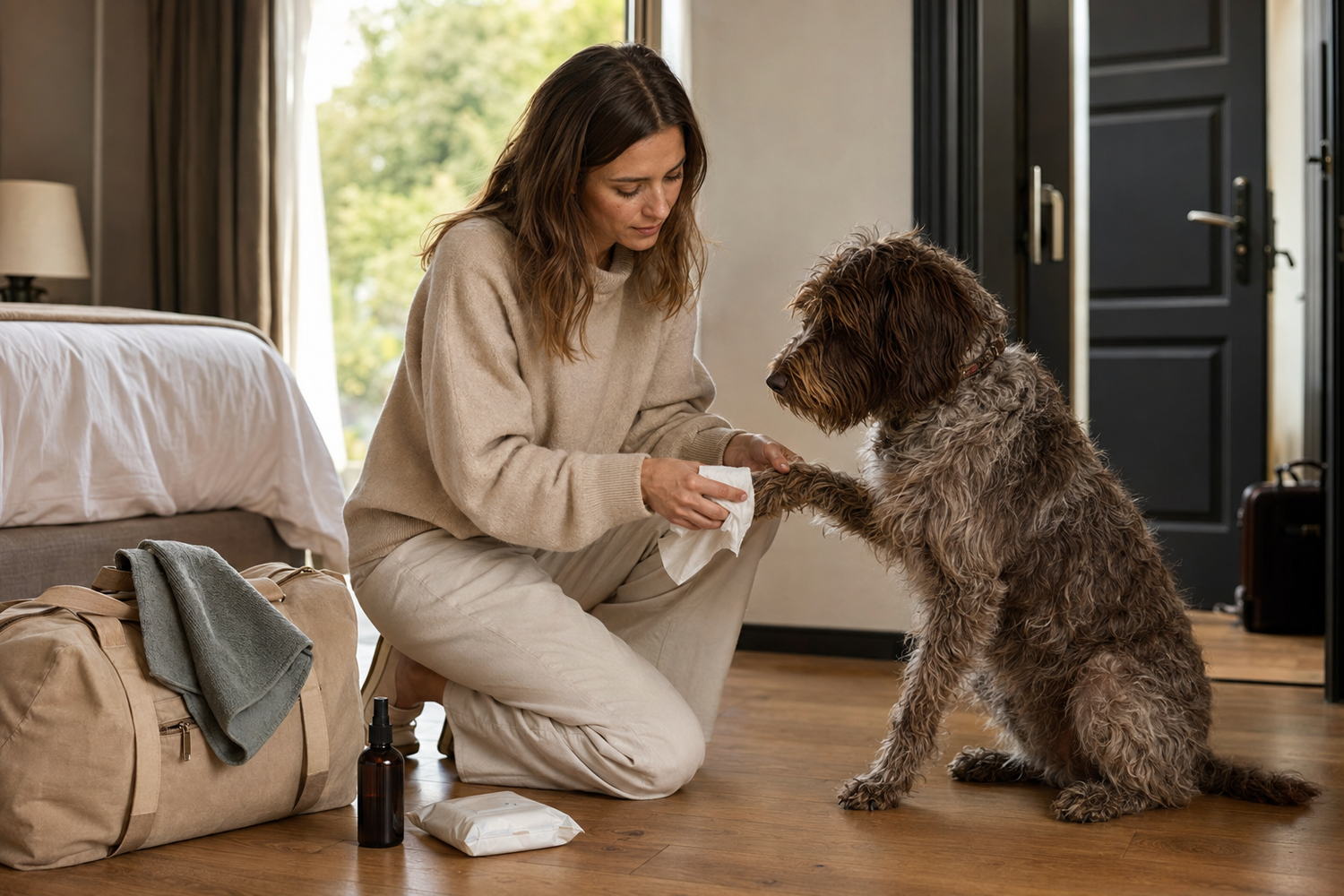
Dog hygiene during travel doesn't mean bathing after every stop. The best routine is short and tailored to the type of dirt: brush off dry particles, dry wet paws, remove localized dirt with water or a dog wipe, and only apply spray to clean fur to facilitate detangling.
This is enough to limit sand on the seat, mud in the hotel room, and tangles after a weekend in the woods – without unnecessary skin irritation or using cosmetics more often than necessary. The key rule is: first assess the dirt, then choose the smallest effective intervention.
In short: the travel ritual in 5 steps
- Before entering the car or hotel, check paws, belly, and fur.
- Remove leaves, sand, burrs, and plant seeds with your fingers or a brush.
- Clean localized dirt with a dog wipe or a damp cloth.
- After mud, salt, or swimming in a natural water body, use clean water and a towel.
- Apply detangling spray to clean, dry, or slightly damp fur and brush gently.
What to pack in your dog's travel toiletry bag?
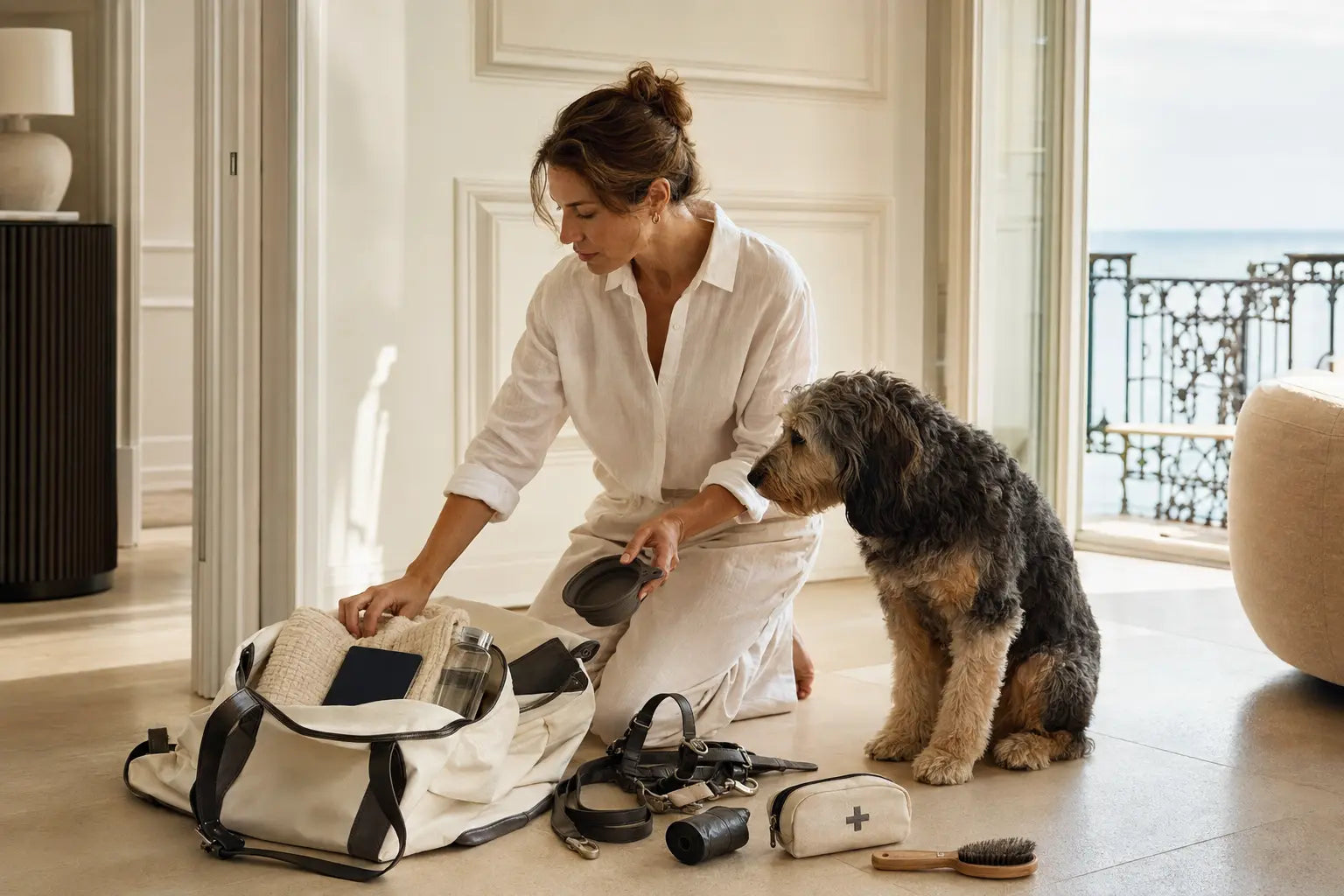
When traveling, it's not about a large number of products, but quick access. The toiletry bag should be by the hotel room door or on top of the luggage, not underneath suitcases. You'll need:
- a small pack of wipes designed for dogs,
- a bottle of clean water and a soft cloth,
- an absorbent towel for the dog only,
- a brush or comb suitable for the fur type,
- leave-in detangling spray,
- bags for used wipes and wet towels,
- a mat or blanket to protect the seat and floor,
- a tool for safe tick removal.
You'll find a complete list of documents, food, first aid kit, and transport equipment in a separate guide: What to take on vacation with a dog? Here, we focus solely on the cleanliness of the skin, paws, fur, and surroundings.
Dog hygiene in the car
Before getting into the car
After a walk, stop your dog on a mat or by the open trunk and perform a quick check. Shake off dry sand, remove visible plant fragments, and check the spaces between the toes. If paws are only dusty, a damp cloth is often sufficient. For wet mud, it's better to use a small amount of water first, then thoroughly dry the paw pads and belly.
Do not try to mask the smell by spraying in a closed cabin. Apply fur product outdoors or in a well-ventilated area, away from the dog's face, and only according to the label. In the car, ventilation, dry fur, and a clean resting place are most important.
During the journey
It's a good idea to place an easy-to-wipe cover under the mat or blanket. Seal wet towels and used wipes in a separate bag, but remove and dry or dispose of them immediately upon arrival – left in a hot car, they quickly become a source of unpleasant odor. Wash bowls regularly and remove spilled water so the dog doesn't lie on a damp surface.
Dog in the hotel: cleanliness without stress
The best time to clean your dog is before entering the room. First, a short walk for physiological needs, then paws, belly, and fur. Such a consistent ritual after each outing is more predictable for the dog than being suddenly grabbed with a towel on a light carpet.
- Set up your own mat by the door and keep a towel and toiletry bag nearby.
- Check each paw, groin area, and lower belly.
- Remove localized dirt and thoroughly dry damp areas.
- Brush long or curly fur over your own towel.
- Spread a blanket or bed in one quiet spot.
Do not use hotel towels to wipe your dog and do not assume that they can get on the bed or sofa – check the facility's regulations. Place bowls on a mat away from traffic areas. After each feeding, remove leftovers, and collect fur and sand before departure. These are small gestures that facilitate future dog-friendly bookings for all owners.
Weekend outside the city: mud, grasses, ticks
Forests, meadows, and country roads leave more than just dust on fur. After a walk, run your hands over your dog's entire body and pay special attention to the ears, neck, armpits, groin, belly, and spaces between the toes. Remove loose plant seeds immediately. If an awn has embedded itself in the skin, eye, or ear, do not pull it out forcefully – veterinary assistance is needed.
Tick repellent reduces risk but does not replace inspection. The European organization ESCCAP recommends regularly checking your dog when traveling and bringing a tick removal tool. After returning, check your dog again, as small parasites are easy to miss in thick fur.
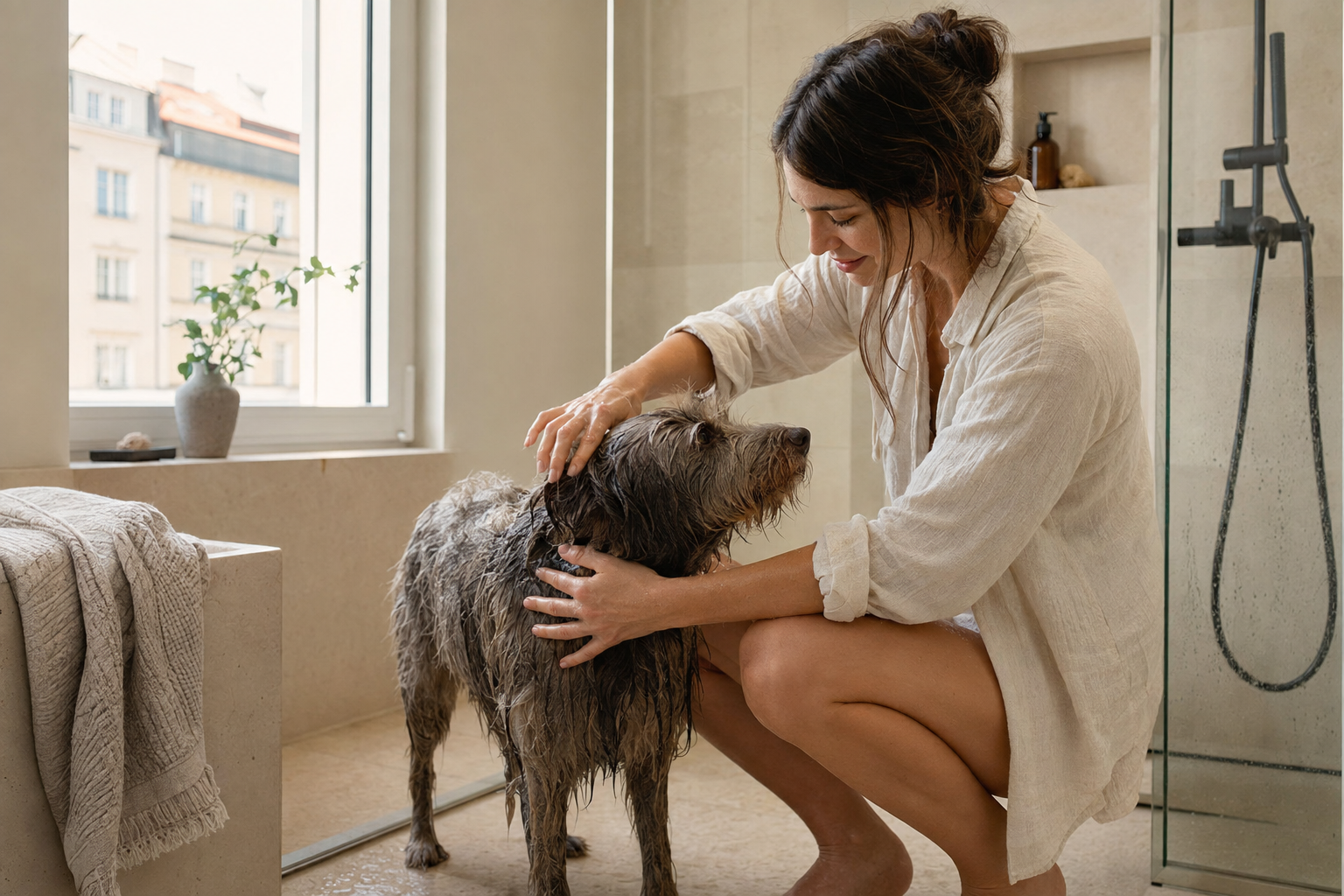
If the weekend includes swimming in the sea or a lake, a wipe alone will not remove salt, sand, or contaminants from the entire coat. Use clean water and follow the ritual described in the article Dog at the sea and lake - how to care for fur after swimming?.
Wipes, water, shampoo or spray - what to choose?
| Situation | Best reaction | What not to do? |
|---|---|---|
| Dry dust, dirt, single dirty paw pad | Brush, damp cloth or dog wipe. | Do not bathe the entire dog unnecessarily. |
| Wet mud, sand, sea salt | Clean water, localized rinsing and thorough drying. | Do not rub dirt with a dry wipe. |
| Tangled, clean fur | Detangling spray and appropriate brush. | Do not yank a dry tangle from the root. |
| Strong odor, greasy dirt, large area of dirt | Bath with a mild product designed for dogs and thorough rinsing. | Do not mask the problem with perfumes or many wipes. |
| Unknown substance, chemicals, irritation or wound | Stop the walk, do not allow licking of the area and contact a veterinarian; determine the rinsing method depending on the substance. | Do not apply spray, balm, or random detergent. |
How to safely use dog wipes?
Wipes are a solution for small and localized dirt. Choose a product described as intended for dogs and read the usage instructions on the packaging. Human wipes, disinfectants, and products with alcohol or strong scents may not be suitable for dog skin.
- Start with the cleanest part and move to the dirtier part.
- Do not rub one area repeatedly – it's better to change the wipe.
- Avoid eyes, nose, mouth, inside of ears, and mucous membranes, unless the label states otherwise.
- Do not use on a wound, blister, painful abrasion, or reddened skin.
- After cleaning, dry the spaces between the toes.
- If the dog licks intensely, scratches, or reddens after use, discontinue use.
A wipe helps maintain cleanliness between baths, but it is not a means to treat skin, clean the ear canal, or remove a tick.
Dog hair spray for travel: when does it really help?
Detangling spray is useful after a windy walk, travel in a harness, and an active day when fur rubs against straps, clothing, or bedding. However, sand, mud, and plant fragments must first be removed. Brushing dirty fur can rub particles deeper and increase friction.
PetsChoice Bubble Gum spray can be used on dry or slightly damp fur, between baths or before brushing. It does not require rinsing. Avoid eyes, nose, and ears, and do not apply the product to irritated skin. After application, gently brush the fur from the ends upwards, holding the section near the skin. Do not forcefully pull matted, painful tangles – it is safer to ask a groomer for help.
TRAVEL RITUAL
Wipes + spray: a duo for minor messes
Dog wipes help quickly clean paws and individual dirty areas, and leave-in spray makes detangling already clean fur easier. This is a travel duo for between baths – not a substitute for water when the dog is truly dirty.
Discover detangling spray →Five-minute ritual after the last walk
- I check paws, belly, ears, armpits, and groin.
- I remove sand, leaves, burrs, and loose grass seeds.
- I clean only the areas that require it.
- I thoroughly dry wet fur and the spaces between the toes.
- I check the skin for redness, wounds, and ticks.
- If necessary, I apply spray to clean fur and brush gently.
- I hang the towel to dry and restock the toiletry bag for the morning.
Regularity is more important than intensity. A quick check after each walk allows you to notice a tick, an awn, chafing from a harness, or moisture between the toes more quickly. This keeps the car and hotel clean, and grooming doesn't turn a shared weekend into a series of unnecessary baths.
FAQ – frequently asked questions
How to care for dog hygiene during travel?
After a walk, check the paws, belly, and fur. Brush off dry particles, remove minor localized dirt with a damp cloth or dog wipe, and dry wet areas. After salt, a lot of mud, or contact with water in a natural body of water, use clean water. A full bath is needed when localized cleaning is not enough.
Can you wipe a dog with wet wipes?
Yes, if they are wipes designed for dogs and you use them according to the label. Do not use random human wipes or disinfectants. Avoid eyes, nose, inside of ears, mucous membranes, and damaged or irritated skin, unless the manufacturer explicitly allows it for that area.
Do dog wipes replace bathing?
No. They are intended for minor, localized dirt. For large amounts of mud, salt, greasy substances, strong odors, or dirt on the entire body, rinsing or bathing with a dog product and thorough rinsing is needed.
How to use dog fur spray when traveling?
First, remove sand, mud, and plants from the fur. Apply the spray to dry or slightly damp, non-irritated fur according to product instructions. Avoid the face, nose, eyes, and ears, then brush gently from the ends, without pulling.
How to prepare a dog for entering a hotel room?
Before entering, let him relieve himself, check and clean paws, dry the belly, and brush off loose sand on his own towel. In the room, place a bowl on a mat and spread your own bed or blanket. Observe the facility's rules regarding furniture and leaving the dog alone.
When does a dog's dirt require a veterinary consultation?
When there is pain, a wound, bleeding, swelling, redness, intense licking, an eye or ear problem, or symptoms after contact with an unknown substance. Do not apply cosmetics to damaged skin and do not forcefully pull out embedded awns.

Leave a comment
This site is protected by hCaptcha and the hCaptcha Privacy Policy and Terms of Service apply.