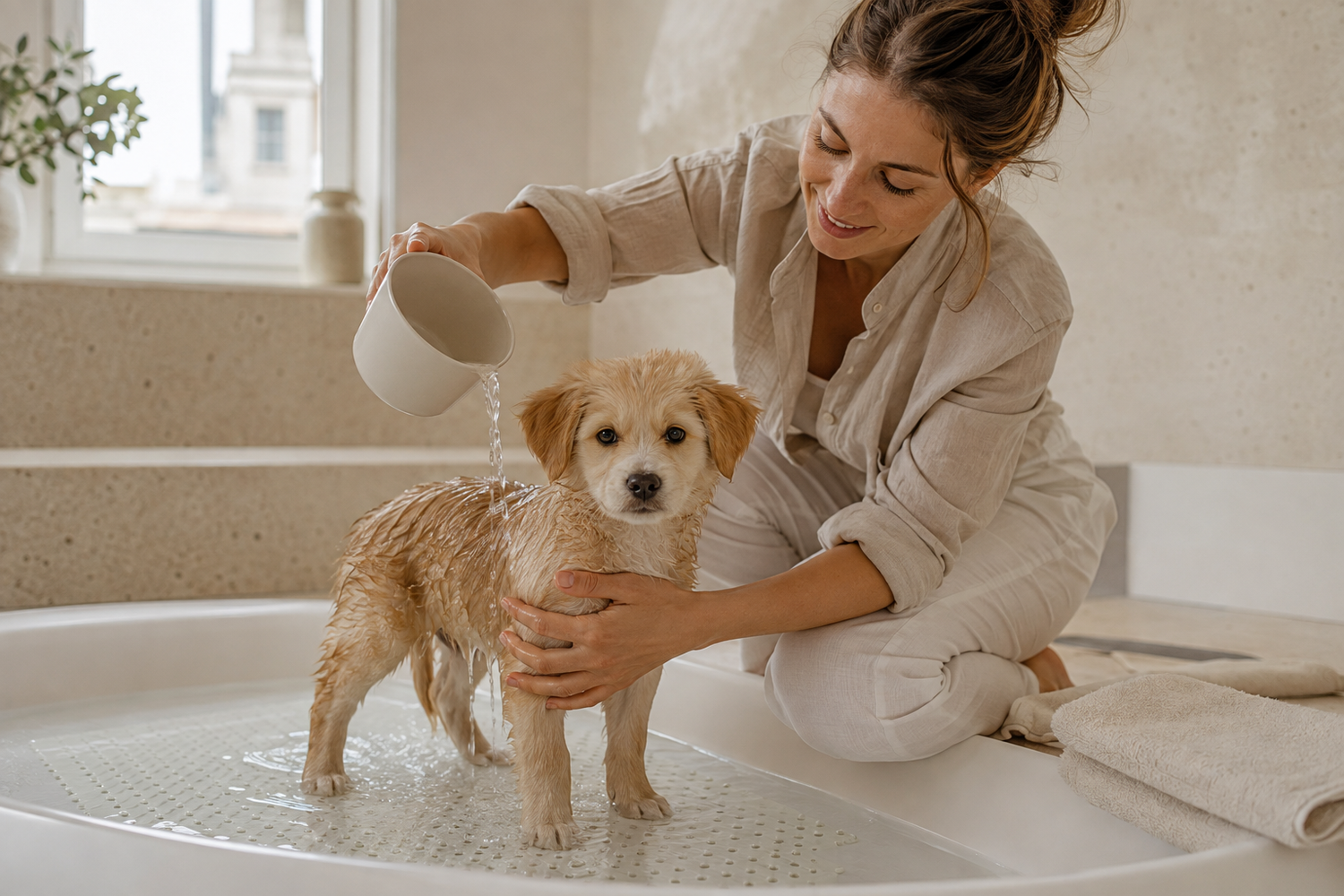
First puppy bath - when, how, and what to avoid?
A puppy's first bath should not happen "as soon as possible", but rather when the dog is healthy, typically at least 8 weeks old, and genuinely needs a full wash. The most important factors are: a warm room, lukewarm water, a non-slip mat, a puppy-specific product, thorough rinsing, and gentle drying.
You don't need to bathe your dog just because they've moved into a new home. If their coat is clean and their skin shows no worrying changes, a better first step might be to accustom them to the bathroom, a towel, and paw touches. However, if they get soiled with urine, feces, mud, or a substance that cannot be safely removed locally, a bath is warranted. VCA Animal Hospitals emphasizes that young dogs in the process of house-training may require immediate washing after significant soiling.
In short: safe first bath
- For a healthy puppy, a full home bath is usually started no earlier than around 8 weeks of age.
- Don't bathe your dog "just because" — for minor dirt, clean only the paws, belly, or muzzle.
- Prepare everything in advance so you don't leave a wet puppy alone even for a moment.
- Use lukewarm, not hot, water and a mild shampoo designed for puppies.
- Do not pour water on the muzzle or into the ears; wipe the face separately with a damp cloth.
- Rinse the product thoroughly and dry the dog in a warm, draft-free room.
When to give a puppy its first bath?
The most commonly cited practical starting point for a healthy puppy is around 8 weeks of age. However, this is not an automatic "bath time". Age only indicates that the dog is better prepared to maintain body temperature than a newborn. The decision is still made based on health, dirtiness, home conditions, and stress tolerance.
| Situation | What to do? | Full bath? |
|---|---|---|
| Puppy is less than approximately 8 weeks old | Clean locally with a warm, damp cloth and dry immediately. For heavy soiling, ask your vet. | Usually not without a clear need or vet's recommendation. |
| Healthy dog over 8 weeks, slightly dusty | Brush the coat or only wash the dirty paws and belly. | Most often not. |
| Urine, feces, heavy mud, or unpleasant odor | Prepare for a short, calm bath and thorough drying. | Yes, if the dirt cannot be removed locally. |
| Itching, redness, sores, dandruff, or unusual skin odor | Do not choose cosmetic products by trial and error. Consult about the skin. | Only as advised by a veterinarian. |
| Recent surgery, wound, stitches, weakness, vomiting, or diarrhea | Postpone the bath and contact your vet. | Not without veterinarian's consent. |
What about vaccinations?
It's worth distinguishing between two situations. Bathing in a clean home doesn't mean contact with other dogs and shared surfaces. A grooming salon, however, does. The RSPCA recommends scheduling the first grooming visit after the puppy has been fully vaccinated; confirm the exact timing with your primary vet and the chosen salon.
After vaccination itself, observe your dog's well-being. If they are sleepy, sore at the injection site, have a fever, or feel unwell, the bath is not urgent — let them rest and contact your vet if symptoms are pronounced or persist.
How to prepare your puppy before turning on the water?
The first bath begins a few days in advance. VCA points out that the goal is not to force the dog to love bathing, but to prevent fear from developing at the sound of the tap. First, place a dry mat in the tub or shower, allow the puppy to step on it for a treat, and end the exercise after a few seconds. The next day, touch the paws with a towel, show the pouring cup, and briefly turn on the water at a distance.
Observe your dog's body language. A relaxed posture, soft gaze, and interest in treats mean you can continue. Stiffening, attempts to escape, intense panting, a tucked tail, whining, or refusing food are signs to reduce the difficulty. Don't wait for fear to turn into panic.
Prepare before bathing
- a non-slip mat or stable rubber liner;
- two soft, absorbent towels;
- shampoo designed for puppies;
- a cup or a weak, handheld stream of water;
- a brush suited to the coat type;
- a few small treats and a calm person to help, if needed.
Close the window, eliminate drafts, and place all items within reach. Put your phone away. A wet puppy should not be left alone in the tub even for a moment. The water should be lukewarm and pleasant to the hand, and its level very low — the dog should stand steadily, not swim.
First puppy bath step by step
- Brush dry fur. Remove loose dirt and minor tangles. Do not pull heavily matted fur; for difficult mats, ask a groomer for safe assistance.
- Place the dog on the mat. With one hand, calmly support the chest or torso. Do not pull on the paws or immobilize the neck.
- Wet from paws and torso. Direct lukewarm water from the neck towards the tail. Leave the head, eyes, and inside of the ears dry.
- Apply a small amount of shampoo. Use a puppy-specific product according to the label. Massage gently with fingertips, without scratching with nails or rubbing hard.
- Observe contact time. Do not shorten or extend it on your own. If the puppy is clearly scared, safety is more important than completing a perfect ritual – rinse off the product and end the session.
- Rinse very thoroughly. Rinse until the water is clear and the fur is not slippery from the product. Shampoo residue can cause discomfort.
- Clean the muzzle separately. Use a clean, slightly damp cloth. Do not pour water on the face or put anything into the ear canal.
- Squeeze water out with a towel. Do not rub vigorously, as this creates tangles and can frighten the dog.
- Dry completely. For short fur, towels and a warm room are often sufficient. Introduce the hairdryer gradually, on a gentle setting, from a safe distance, and with constant temperature control.
- End with success. Reward the puppy, let them rest, and observe their skin and behavior for the next 24 hours.
The entire first session should be short. The goal is not a salon-perfect result, but a clean dog and a good memory. If only the paws or belly are dirty, do not wet the entire body. For daily hygiene, the guide How to care for your dog's hygiene at home? will also be helpful.
What shampoo to choose for a puppy?
A dog's skin has different needs than human skin, so PDSA recommends a cosmetic specifically developed for dogs. Shampoo for adults, children, or babies is not a safe substitute for a puppy's routine bath. Choose a product clearly intended for young dogs, read the instructions, and don't assume that more foam means better cleaning.
When using it for the first time, observe the skin for 24 hours. Increased scratching, redness, swelling, hives, vomiting, restlessness, or sudden weakness require discontinuation; for a strong reaction, immediate contact with a veterinarian is needed. If the puppy already has itching, dandruff, hair loss, pimples, sores, or an unpleasant skin odor, the choice should start with a diagnosis, not a fragrant cosmetic.
First ritual PetsChoice.Club
Puppy Soft or a complete starter kit
Puppy Soft Peach and Pineapple Shampoo has been developed for gentle puppy care. Apply it to thoroughly wet fur, gently massage to create lather, leave for 3–5 minutes, avoiding the eye and ear area, then rinse thoroughly with warm water.
The Puppy Starter Kit combines Puppy Soft with paw soap and paw and nose balm. This is a simple start to a routine: a full bath only when needed, and local care after daily walks.
See Puppy Soft → See puppy kit →What to avoid during the first bath?
- Do not use human or baby shampoo. Choose a cosmetic developed for dogs and appropriate for their age.
- Do not place the dog in deep water. A stable surface gives them a sense of control and reduces the risk of slipping.
- Do not pour water on the muzzle. Clean it separately with a damp cloth, without getting water in the eyes or ears.
- Do not forcibly restrain a panicked puppy. Rinse off the product, end the bath, and return to short, water-free desensitization.
- Do not use a hot hairdryer or a closed cage dryer. The RSPCA warns against equipment from which the dog cannot move away from the heat source on its own.
- Do not leave a damp dog by an open window. The puppy should dry in a warm, draft-free room.
- Do not bathe too often. When dirt is localized, apply the least effective grooming instead of a full wash.
- Do not mask skin symptoms with fragrance. Itching, sores, flaking, pustules, and unusual skin odor require veterinary assessment.
If you want to establish a later bathing routine, read the guide How often to bathe your dog in summer?. The rule remains the same all year round: bathe your dog according to actual need, coat type, and skin condition, not just according to the calendar.
FAQ — frequently asked questions
When can a puppy be bathed for the first time?
For a healthy puppy, the first full home bath is usually planned no earlier than around 8 weeks of age and when it is actually needed. A younger dog is better cleaned locally with a warm, damp cloth and dried immediately, unless advised otherwise by a veterinarian.
Can a puppy be bathed before vaccinations are complete?
If a healthy dog needs washing, bathing can be done in a clean home without contact with other animals. A grooming salon is a different environment, so the first visit is best planned after full vaccination and after confirming the appointment with your veterinarian.
How often should a puppy be bathed?
Only as needed. If the coat is slightly dusty, a brush is enough. If the paws or belly are dirty, wash those areas locally. Perform a full bath when the coat is noticeably dirty, sticky, or has an unpleasant odor.
What shampoo to choose for the first bath?
A mild shampoo designed for dogs and labeled as a puppy product. Use it exactly according to the label. Do not use human or baby shampoo. For skin conditions, the product should be chosen by a veterinarian.
How to dry a puppy after bathing?
Gently blot water with a soft towel. If the dog tolerates a hairdryer, choose a gentle setting and safe temperature, hold the device at a distance, and constantly monitor the heat with your hand. The puppy should remain in a warm room until completely dry.
What to do if the puppy is afraid of water?
Do not force it into a long bath. Practice short elements separately: stepping onto a dry mat, contact with a towel, the sound of the tap, and wetting one paw. Reward calmness. For severe fear, ask a veterinarian or qualified behaviorist for a gradual desensitization plan.

Leave a comment
This site is protected by hCaptcha and the hCaptcha Privacy Policy and Terms of Service apply.